Insights
In complex multi-market environments, performance is rarely defined by operational efficiency alone. It is shaped by judgement under constraint, disciplined capital allocation, and the ability to recalibrate trade-offs under structural pressure.
These reflections draw on direct operating accountability across capital-intensive systems operating under volatility. They focus on governance clarity, operating model maturity and the discipline required to sustain enterprise durability across cycles.
Capital Discipline Under Geopolitical Volatility
Periods of geopolitical instability rarely damage organisations through inflation alone. The greater risk lies in how leadership recalibrates trade-offs under stress.
Cost pressure encourages rapid action. Volatility demands resilience. Capital tightens. Decision velocity increases while clarity often decreases.
In multi-market environments spanning diverse regulatory, economic and political landscapes, inflation does not manifest uniformly. Network exposure varies by geography. Currency impacts diverge. Service risk is uneven. Governance discipline becomes the difference between temporary cost response and structural value erosion.
Under sustained geopolitical volatility, several enterprise trade-offs sharpen:
Speed versus resilience
Rapid cost reduction may protect margin in the short term but weaken network durability and supplier stability.
Working capital versus service protection
Inventory compression can preserve cash yet amplify service risk when demand signals distort.
Central control versus local autonomy
Global policy alignment must balance with regional execution realities in politically fragmented environments.
Data versus executive judgement
Forecast models lose predictive strength as volatility accelerates. Leadership maturity is revealed in how data is interpreted, not merely reported.
Investment timing
Automation and digital programmes cannot be assessed solely on immediate return under inflationary pressure. Long-term system resilience must be weighed against short-term margin optics.
Organisations that endure geopolitical volatility are not those with the lowest cost base. They are those with aligned decision rights, disciplined capital allocation and governance structures capable of absorbing structural shock.
Trade-offs do not disappear during volatility. They intensify.
Executive Articles
These articles examine how enduring enterprises are constructed through disciplined capital decisions, operating architecture and governance clarity.
Written from direct operating experience across complex, multi-market environments, they focus on comparison, stewardship and long-term value creation.
The Board’s One Job That Cannot Be Delegated
Capital allocation determines whether enterprises compound or quietly dilute. This article examines how capital is raised, compared and deployed across cycles, and why governance most often weakens not through error, but through the absence of disciplined comparison.
What Boards Actually Mean When They Ask About Return
Investment discussions at board level rarely centre on mathematics alone. Behind every question about return sits a deeper assessment of comparative discipline, risk maturity and leadership judgement. The numbers frame the debate. The architecture of thinking determines the decision.
Working Capital as a Leadership Discipline
Working capital determines capital velocity and enterprise freedom. In volatile systems, liquidity discipline is a governance outcome that shapes optionality, risk perception and long-term value.
Margin Pressure as Structural Reality
Margin compression is now structural rather than cyclical. This article examines how operating model design, capital sensitivity and governance clarity determine whether economics erode or endure in elevated cost environments.
Geopolitics as an Operating Constraint
Geopolitical fragmentation is no longer episodic disruption. It is a structural boundary condition reshaping capital allocation, operating architecture and enterprise resilience across cycles.
Published Work
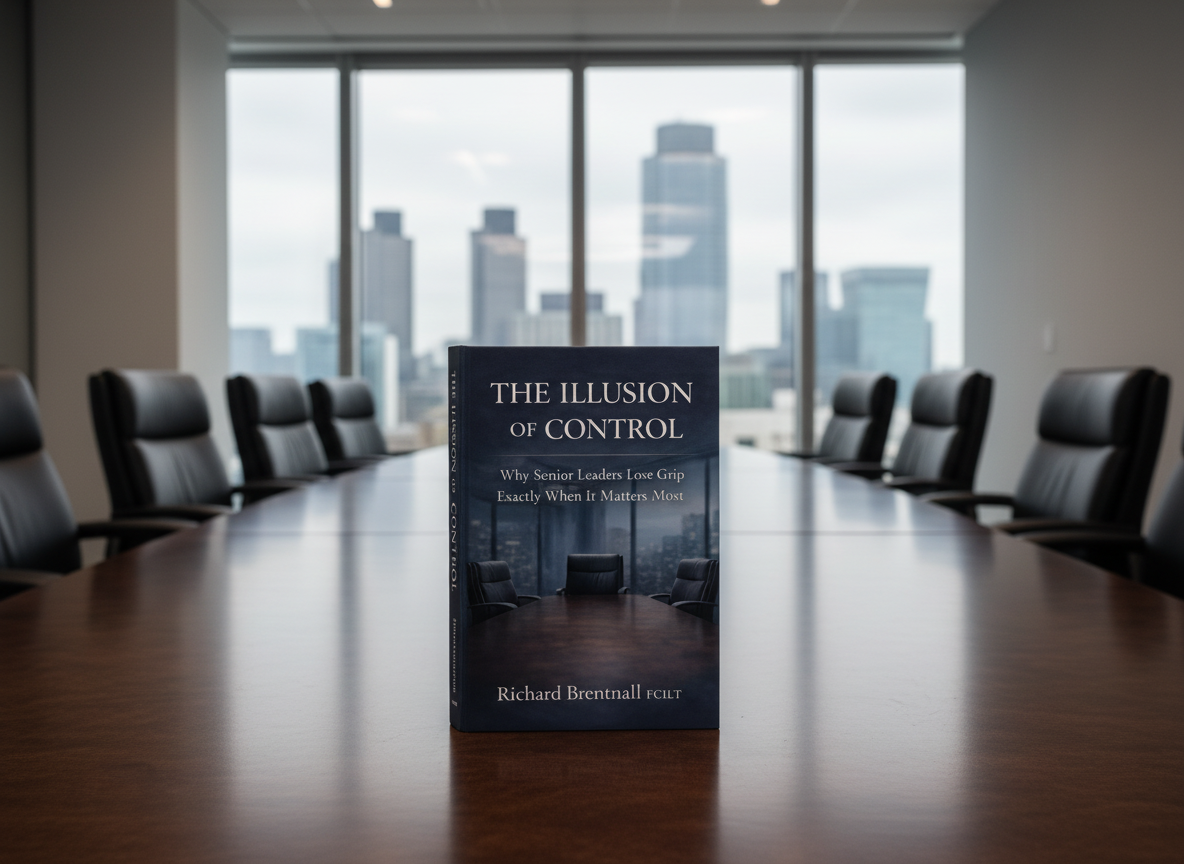
The Illusion of Control
Why Senior Leaders Lose Grip Exactly When It Matters Most
Senior leaders are expected to be in control. Strategy is approved, dashboards are reviewed, execution is monitored. From the outside, control appears firm. Yet organisations often drift into failure without visible disruption.
The Illusion of Control examines how control behaves at senior levels inside complex organisations and why it erodes quietly as scale increases. Drawing on experience across founder-led businesses and FTSE 100 environments, it explores how systems designed to create grip often produce distance. Dashboards replace judgement. Strategy closes inquiry. Reassurance displaces contact.
The work is written for leaders already accountable for outcomes and comfortable confronting ambiguity. It focuses not on tools or prescriptions, but on recognising where control is quietly lost long before performance visibly declines.
Enterprise performance is sustained through disciplined judgement, aligned governance and long-term capital stewardship.